You’re twice as likely to succeed if you have a plan…. Having identified a specific goal that you are training for, work with a coach to clarify your goal’s performance requirements. Have a sensible, tailored plan created for you, with 1:1 feedback throughout and clear metrics to track progress.
The purpose of any coach-athlete relationship should be relatively obvious: to improve & achieve a designated sporting performance. To that end, it can initially appear that the coach ‘coaches’ and the athlete ‘does’, resulting in a particular outcome. However, for any coach-athlete relationship to truly succeed, the coach/athlete boundaries must be allowed to shift, blur or even disappear.
The first element the pair need to balance is the athlete’s understanding of the demands of their event, and the work required to achieve that. The goal(s) must be realistic and provide enough time to incrementally increase the training load such that adaptation (the process by which the athlete’s body gets used to performing at greater levels) can take place. It’s important at this time that the coach & athlete agree not only on a target performance but also a general outline of the training phases required. This could be an increased period of endurance rides, more specific gym work, longer reps at threshold or any combination of different sessions. One thing is clear: you can’t improve all your weaknesses at the same time. We need to balance the need to get ‘faster’ with the desire to improve all our weaknesses. Choices must be made on what elements you need to, & have time to, improve.
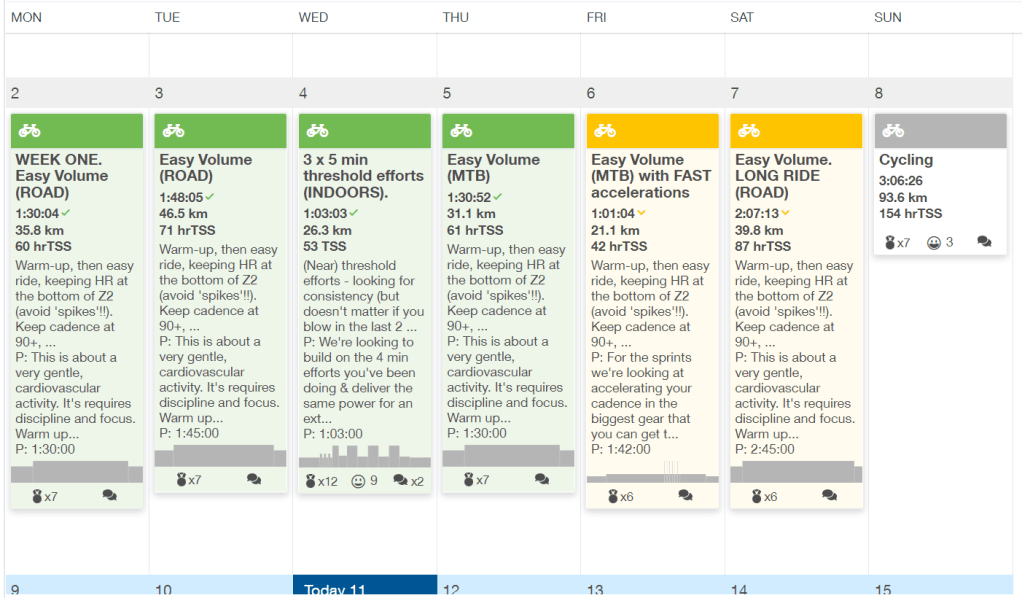
Once the general phases have been agreed upon between the athlete and coach, they can start to map out the specific sessions, creating the correct balance of load, fatigue, and rest. As we mentioned earlier, the design of the sessions should see them get marginally harder each week – too hard & the athlete risks accumulating too much fatigue, too quickly, then having to ‘back off’. Too easy, & the risk is stagnation. Therefore, balancing how much harder each week’s load is, versus when to schedule ‘recovery weeks’ becomes a point of trust between athlete & coach – the athlete must be honest with his feedback & sensations and the coach must be attentive to what he understands to be happening, flexing the load accordingly. If the rider has access to a power meter (a device that measures the force produced by the rider, in ‘Watts’, in propelling the bike/rider combination forward) then this can be combined with the heart rate & each device can be used to sense check the other. Ultimately, any rider will always want to produce more power. If we can measure, track and improve an athlete’s power, we can track his/her overall improvement. The Training Peaks platform allows us to upload, store, evaluate & analyze every metric of every session. As a coach, my job is to interpret the right data in the right way…..online tools can indicate ‘freshness’ but never underestimate an athlete’s own ‘feel’.
 Nidas Cycle Coaching